Monday, May 15, 2017

சித்தர்களுக்கு முழு முதற்கடவுள்" "வாலைத்தாய்"


Thank: https://sivarppanam.blogspot.com/2014/12/blog-post_38.html
https://ravindhaa.blogspot.com/2017/02/


வாலாம்பிகை (சித்தர்களின் தெய்வம்)
image from whatapp
வாலாம்பிகை பற்றி எழுத வேண்டும் என்ற எண்ணம் பல நாட்களாக இருந்து வந்தது.இவள் சித்தர்களுக்கு முழு முதற் கடவுள்.இவளைக் கொண்டே அறுபத்து நாலு கலைகளையும் சித்தர்கள் அறிந்தனர். இவளை திரிபுரை என்றும் , வாலை என்றும் ,பத்து வயதானவள் என்றும், பதினாறு வயதாள் என்றும், கனியென்றும்,பச்சை நிறத்தாளென்றும் ,சக்கரத்தாளென்றும் , வாமியென்றும் ,தேவியென்றும், மாயையென்றும், புவனையென்றும், அன்னையென்றும், ஆவுடையாளென்றும், தாரையென்றும் , அமுதக் கலசமென்றும்,தாயென்றும் உண்ணாமுலையென்றும் ,கோவுடையாளென்றும் , அண்ட பேரண்டங்களைக் கட்டிக் காக்கின்ற அகிலாண்ட கோடி பிரம்மாண்ட நாயகி என்றும் அழைப்பார்கள். வைத்தீஸ்வரனான ஈஸ்வரனே இவள் தயவில்தான் மண்ணையே மருந்தாகக் கொண்டு வைத்தீஸ்வரன் கோவிலில் வைத்தியம் புரிந்து வருகிறான்.இவளை அறிய ஏழு பிறப்பில் புண்ணியம் செய்திருக்க வேண்டும் என்கிறார்கள் சித்தர்கள். இவளால் தர இயலாதது எதுவும் இல்லை. இவளைப் பூசை செய்யும் செய்யும் முறையைப் பற்றி சட்டை முனி கூறுவதைப் பாருங்கள்.
சட்டை முனி ஞானம் -4  பூசை செய்யும் முறை

காணப்பா பூசை செய்யும் முறையைக் கேளாய் கைம் முறையாய்ச் சுவடி வைத்துப் பூசை செய்வார்பூணப்பா சிலபேர்தான் தீபம் வைத்துபுகழாக பூசை செய்வார் பெண்ணை வைத்தும்நாளப்பா சக்கரத்தை பூசை செய்வார்நம்முடைய பூசையென்ன மேருப் போலேஓதப்பா நாற்பத்து முக்கோணம் வைத்தேஉத்தமனே பூசை செய்வார் சித்தர்தானே! பாடல் (1)தானென்ற மேருவைத்தான் பூசை செய்வார்சாபமிட்டால் அண்டரண்டம் தீயா வேகும்தேனென்ற மேருவுக்கு தீட்சை வேண்டும்சிறுபிள்ளையாமொருவன் தீண்டப் போகாவானென்ற மேருவைத்தான் பூசை செய்தோர்வாய்திறந்தே உபதேசம் சொன்னாராகில்கோனென்ற வாத சித்தி கவன சித்திகொள்ளையிட்டான் அவன் சீடன் கூறினானே! பாடல் (2)கூறியதோர் வாலையின் மூன்றெழுத்தைக் கேளாய்குறியறிந்து பூசைசெய்து பின்பு கேளாய்மாறியதோர் திரிபுரையெட் டெழுத்தைக் கேளாய்மைந்தனே இவளை நீ பூசைபண்ணதேறியதோர் புவனைதனின் எழுத்தைக் கேளாய்திறமாக புவனையை நீ பூசை பண்ணுஆறியதோர் யாமளை யாறெழுத்தைக் கேளாய்அவளுடைய பதம் போற்றி பூசை பண்ணே! பாடல் (3)பண்ணிய பின் யாமளையை ஐந்தெழுத்தைக்  கேளாய்பண்பாக தீட்சையைந்தும் முடிந்தபின்புவன்னியதோர் வாசியென்ற யோகத்துக்குமைந்தனே வைத்துப் பிராயாமந் தீரும்கன்னியதோர் இத்தனையு மறிந்திருந்தாற்காயசித்தி விக்ககினங்கள் இல்லை யில்லைஉன்னியதோர் உலகமென்ன சித்தரென்னஉத்தமனே விட்டகுறை எடுக்கும் காணே! பாடல் (4)

சிலர் தீபம் வைத்து பூசை செய்வார்கள் . சிலர் இந்த வாலைப் பெண்ணை வைத்து பூசை செய்வார்கள் . சிலர் சக்கரத்தை வைத்து பூசை செய்வார்கள் .சிலர் மகா மேருவை வைத்து பூசை செய்வார்கள் .சித்தர்கள் நாற்பத்து முக்கோண சக்கரத்தை வைத்து பூசை செய்வார்கள் சித்தர்கள் .  மேருவைப் பூசிக்கின்றவர்கள் சாபமிட்டால் அண்டரண்டமெல்லாம் தீயாய்ப் பிடித்து வேகும். இதற்கு தீட்சை அவசியம் வேண்டும் . சிறுபிள்ளைபோல எண்ணி யாரும் இதைத் தொடல் ஆகாது.வான் தத்துவமாகிய இந்த மேரு பூஜை செய்கிறவர்கள் வாயைத் திறந்து யாருக்காகிலும் உபதேசம் ( இரு தேசங்களைப் பற்றிய ரகசியங்களை) சொல்ல முற்படுவரானால் , அவர்களுக்கு ஞான , யோக, வாத ரகசியங்கள் எல்லாம் வசப்படும்.
வாலையின் மூன்றெழுத்தான அகார , உகார , மகாரத்தின் குறி எது என்றுணர்ந்து பூசை செய்வாய்.திரிபுரையின் எட்டெழுத்தை (தமிழில் எட்டுக்கு அ என்பதே குறி) புரிந்து பூசை செய்வாய்.எட்டும் இரண்டுமாகிய ( இரண்டுக்கு தமிழில் உ என்பதே குறி ) இதை உணர்ந்தால் வாலைத்தாயின் இருப்பிடம் தெரியும் .அவள் அருள் உனக்குக் கிடைக்கும். யாமளையாகிய அவளின் ஆறெழுத்தையும் நீ உணர்ந்து பூசை செய்வாய்.
ஐந்தெழுத்தாகிய பஞ்ச பூதங்களின் உறைவிடத்தைக் காண்பாய் . இந்த ஐந்தெழுத்து மந்திரத்தை அறிந்த பின், வாசியை உணர்ந்து கொள்.இதில் வகாரமான காற்றையும் , சிகாரமான நெருப்பையும் உணர்ந்து ( இதையே நாயோட்டும் மந்திரம் நமனை வெல்லும் என்கிறார் திருமூலர். நாயை எப்படி ஓட்டுகிறோம் , சி என்றல்லவா?இந்த சிகாரமான நெருப்பு யமனை வெல்லும். ) வகாரமான காற்றையும் சிகாரமான நெருப்பையும் சரியாக வைத்துக் கொள்ளாமல் இறந்துவிட்டான் என்பதால்தான் , இறந்து போனவனின் எலும்பில் பாலூற்றும் போது காசி ,காசி என்று ஊற்றுகிறார்கள். அவன் இவற்றை சரியாக பராமரிக்காமல் இறந்து போனான் ,உயிரோடிக்கும் நீயாவது இறக்காமல் இருந்து கொள் என்றுணர்த்தவே சடங்குகள் ஏற்படுத்தப்பட்டன . இறந்தவனை கொண்டு போகும் போது  உறுமி மேளம் அடிப்பார்கள் , அது உண்டுண்டு என்றடிக்கப்படும் . அதாவது இந்த மரணம் உனக்கும் உண்டு , உனக்கும் உண்டு என்று உணர்த்தவே ஆகும் .
உத்தமனே முந்தைய பிறவிகளில் இந்த வாலையைத் தியானித்திருந்து அரைகுறையாக விட்டிருந்தால் , அந்த விட்ட குறை , அந்தப் புண்ணியம் இந்தப் பிறவியில் தொடர்ந்து வந்து ஞானத்தைத் தந்தே தீரும் . இதை அந்த வாலைத் தாய் மரணமில்லாப் பெருவாழ்வை  நிறைவேற்றித் தருவாள்.Image may contain: 1 person, standing
பட்டினத்தார் ஞானம் -100

நெஞ்சமுடனே தாம்புலம்பி நீலநிறத் தாளீன்றகுஞ்சரத்தை யாதரித்து கும்பிட்டால்- தஞ்சமுடன்காமமுதல் மும்மலத்தின் கட்டறுத்து ஞானமுடன்பூமிதனில் வாழ்வரெ ப்போதும்  பாடல் (1)ஆவுடையாளொடிருந்தேன் அருளானந்தம் பெறவேகோவுடையாள் நின்றதினம் கூடிய – பூவுடையாள்கட்டழகியைத்தான் கடந்து பெருவெளியில்இட்டமுடன் நெஞ்சே இரு (பாடல் 4)

நெஞ்சமுடன் தாம்புலம்பி , நீலநிறத்தாள் ஈன்ற குஞ்சான அகார , உகாரத்தைக் கும்பிட்டால் , நம்மைத் தஞ்சமடைந்திருக்கின்ற காமம் முதலான மும்மலத்தின் கட்டறுந்து ஞானத்துடன் பூமியில் வாழ்ந்திடுவார்கள் எப்போதும். பட்டினத்தார் ஆவுடையாளோடிருந்தேனென்றும் (வாலைத் தாயுடன் இருந்தேன் ) , அவளுடைய அருளானந்தம் பெற்று , பூவுடையாள் கட்டழகியைத்தான் கடந்து , வேதாந்தப் பெருவெளிக்குள்   இட்டமுடன் நெஞ்சே இரு என நெஞ்சுக்கு கட்டளை இடுகிறார்.
இந்த வாமியான வாலையைக் கனவினில்  கண்ட காட்சியையும் , அவளிடம் கேட்ட வரம் பற்றி பாரதியார் தனது பாடலில் கீழ்க்கண்டவாறு எழுதுகிறார்.                             மங்கியதோர் நிலவினிலே கனவினிது கண்டேன்.வயது பதினாறிருக்கும் இளவயது மங்கை! பொங்கிவரும் பெருநிலவு போன்ற ஒளிமுகமும், புன்னகையின் புதுநிலவும்  போற்ற வரும் தோற்றம்! மங்கியதோர் நிலவினிலே கனவினிது கண்டேன்! துங்க மணி மின்போலும் வடிவத்தாள் வந்து, துங்க மணி மின்போலும் வடிவத்தாள் வந்து,தூங்காதே எழுந்தென்னை பாரென்று சொன்னாள்! அங்கதனில் கண்விழித்தேன் !அடடா ஓ அடடா!
அழகென்னும் தெய்வம் அதுவென்றேயறிந்தேன்! காலத்தின் விதி மதியைக் கடந்திடுமோவென்றேன்? காலமே மதியினுக்கோர் கருவியாம் என்றாள்! ஞாலத்தில் விரும்பியது நண்ணுமோ வென்றேன் ? நாலிலே ஒன்றிரண்டு பலித்திடலாம் என்றாள்! மங்கியதோர் நிலவினிலே கனவினிது கண்டேன்! – பாரதியார் –
முதலில் அந்த வாலாம்பிகையின் காட்சியை வருணித்த பாரதியார் , வாலாம்பிகையிடம் காலத்தின் விதி தமது மதியைக் கடந்திடுமோவென்று கேட்கிறார்.அதற்கு வாலாம்பிகை காலமே மதியினுக்கு ஓர் கருவி என்று கூறுகிறாள். இந்த உலகத்தில் விரும்பியது கிடைக்குமா என்று வினவுகிறார் பாரதி , அதற்கு வாலைப் பெண்ணாத்தாள் , நாலில் ஒன்றிரண்டு கிடைக்கலாம் என்றாள்.
வாலை தெய்வம்★
★வாலையை பணியாமல் சித்தராக முடியாது!
★அவளை யறியா அமரரும் இல்லை
★அவளின்றிச் செய்யும் அருந்தவம் இல்லை
★அவளின்றி ஐவரால் ஆவதொன் றில்லை
★அவளின்றி யூர் புகு மாறறி யே னே"
★அவள் - சக்தி - வாலை - தாய் - 'உ' இடது மணி ஒளி! சக்தியை அறியாத தேவர் யாருமில்லை? ஏன் தெரியுமா? சக்தி அருளால் அமுதம் உண்டு தான் அமரத்துவம் பெற முடியும்!
★அப்படியாயின் அமரர் சக்தியை வாலையை அறியாமலிருப்பரா?
★ சக்தியில்லையேல் நம்மால் எதுவுமே செய்ய முடியாதே!
★உடலில் சக்தி இருந்தால் தானே நடமாட முடியும்!
★பின்னரல்லவா தவம் செய்வது?! ஆக சக்தி இல்லையெனில் ஒன்றும் செய்ய இயலாது!
★சக்தி - வாலை துணையின்றி பஞ்சகிர்த்தியம் புரியும் மூர்த்திகளாலும் ஒன்றும் செய்ய இயலாது!
★பஞ்ச பூதங்கள் இயங்க சக்தி வேண்டும். நம் புலன்கள் இயங்க சக்தி வேண்டும்!. ஏன்? சிவத்தோடு சக்தி இருந்தாலே இயக்கம்! எங்கும் சிவமயம்! சிவம் சக்தி மயம்!
★அவளே வாலை! தாய்!
★அந்த தாய் வாலை அருள் தந்து அமுதம் ஊட்டி அவள் ஆசி பெற்றே சிவன் இருக்கும் ஊருக்கு போக முடியும்!
★சிவனருள் பெற முதலில் சக்தியருளே வேண்டும்!
★நம்மை கருவாய் வயிற்றில் சுமந்து பெற்ற தாயை விட கோடி கோடி பங்கு நம்மை அன்புகாட்டி அமுதூட்டி அரவணைபவள் வாலைதாயே!
★நமது உடலுக்கு சக்தி யூட்டிய தாய்!
★உலக அன்னை ! அண்டமெல்லாம் நிறைந்த அகிலாண்டேஸ்வரி !
★அவளை அறியாத பேர்க்கு மாயை! மகாமாயை அவளே! அறிந்து பணிந்தவருக்கு அமுதூட்டும் அன்னை!
★வாலையை பணியாமல் யாரும் தேவராக முடியாது! சித்தராக முடியாது! ஞானியாக முடியாது! சிவமே சக்தியை தன்னோடு சரிபாதி யாக கொண்டார் எனில் சக்தியின் மகத்துவம் புரியவேண்டாமா?
★"சின்னஞ்சிறு பெண் போலே சிற்றாடை இடை உடுத்தி
செம்பவள மேனி கொண்ட சக்தியவள் வாலையே!
முக்கடலும் சங்கமிக்கும் முக்தி யருள் தலமாம்
கன்னியவள் குமரி யிலே கண்டு கொள் பணிந்தே"
“எல்லா உயிர்களும் இன்புற்று வாழ்க ஆன்ம நேய ஒருமைப்பாடு உலகெங்கும் ஓங்குக.”
இன்புற்றிருக்க ஈசனுடன் உறைந்ந அன்னையை சரனடைவோம்
சிவ சக்தி போற்றி.
அம்மா தாயே சரணம் 
வாலையைக்கும்பிட்டு சித்தரானார்..
வாலைக்கொத்தாசையாய் சிவகர்த்தரானார்... 
வாலைக்கு மேலான தெய்வமில்லை....
கொங்கண சித்தர் ...
தாயிர் சிறந்த கோயிலும் இல்லை 
தந்தை சொல் மிக்க மந்திரம் இல்லை
சக்தி இல்லையேல் சிவம் இல்லை
அவளை அறிய முதலில் ஐவரை அறிய வேண்டும் 
இருப்பிடம் உள்நாக்கு 
இயக்குவது காற்று
கன்னி வாலை பெண்ணாகி தாயுமாகி உயர்ந்து நிற்கும் உன்னத தாய்மை பொருந்திய உண்மை தெய்வம்.

Friday, May 12, 2017

Antar Mouna Sannyasi Atmatattwananda (UK)


thank : https://www.yogamag.net/archives/2002/cmay02/amtarm.shtml

Image result for antar mouna

Antar Mouna

Sannyasi Atmatattwananda (UK)


When the mind is silent and peaceful it becomes very powerful. It can become a receptor of bliss and wisdom enabling life to become a spontaneous flow and expression of joy and harmony. However…this inner silence cannot arise while there is a continual stream of disturbing thoughts and emotions. All this inner noise of thoughts and emotions has to be removed before one can truly experience the soundless sound of inner silence.

—Swami Satyananda Saraswati
Peace, bliss, harmony. Who is able to experience these states? So many people these days are struggling with their own minds. Influenced by their conditionings, and overwhelmed by the pressures of day to day living in today's increasingly stressful society, they are full of mental tensions, which manifest as anxiety, nervousness, guilt, lack of self-confidence, loneliness, fear, obsessions and phobias. Some turn to drugs and alcohol as a temporary means of escape and solace. Others enlist the costly help of psychiatrists or psychotherapists to try and cope. All are looking for some form of change, a little relief from the inner conflicts and turmoil, wanting to feel at ease with themselves, or even to experience, if not bliss, just a modicum of peace and contentment.
Those who are fortunate enough to come across Satyananda Yoga can encounter and learn an excellent systematic meditation practice, known as antar mouna, that will enable them to release these oppressive mental tensions and to become their own psychotherapists in the process.
Antar means inner, mouna means silence. Antar mouna is a technique of attaining pratyahara (withdrawal of the mind from the sense objects), the fifth stage of raja yoga, and in its fullest form can lead to dharana and dhyana. Antar mouna is also a fundamental part of the Buddhist practice known as vipassana, used in a modified way.
Image result for antar mouna

Purging the mind

Generally we tend to allow 'good' thoughts to arise to conscious perception; we accept and enjoy pleasant thoughts. When an unpleasant, painful or 'bad' memory or thought arises, we tend to quickly push it back down into the subconscious layers of the mind. This is suppression and we all do it. Everyone has mental suppressions. Often we are conditioned to do it from childhood. But suppression is definitely not the answer.
Every single suppressed thought that remains unexpressed causes a block in the free flow of the mind. The thoughts and experiences stay submerged in the subconscious realms of the mind in seed form, causing pain, unhappiness and frustration in life. These subtle impressions are known as samskaras. Without even realizing it, we build up a vast accumulation of suppressed thoughts which cause a lot of tension and disturbances in the mind and personality without obvious cause.
To find lasting happiness or peace of mind, these mental impressions have to be rooted out. It can be compared to gardening. We remove the unwanted weeds from the mind. If we just break the top off, although there is temporary relief, the weed will return. However, when we dig down deep and pull out the root of the weed, it loses its hold and can be removed completely. If left to fester in the mind, these negative mental impressions poison the psyche and lead to irritability, aggression, anger, non-specific depression, a tendency to worry, being fearful without reason, and permanent tiredness. This affects all our interactions in life and reduces our ability to be efficient, creative and dynamic at every level of our lives.
Antar mouna enables us to exhaust these unwanted thoughts; it provides a means to purge the mind. Once these mental tensions start to be released, we can experience corresponding surges of energy and inspiration and life starts to take on a new dimension. In the same way that we clean our rooms and the physical body every day we also need to develop the habit of cleaning the mind each day in order to prevent the accumulation of more dross or rubbish. Therefore, it is very necessary to repeat this process on a consistent and regular basis.
The practice of antar mouna is divided into six stages: For most people, the first three stages provide plenty to work with, and in order to obtain the full benefits, a considerable amount of time should be spent practising and perfecting them before attempting to move into the more advanced stages, which will only be touched upon in brief here.

Stage 1: Awareness of external sensory perceptions

Stage 1 of antar mouna is concerned with the sensory perceptions of external stimuli. The awareness is consciously directed to focus on the sense of taste, then to witness any smells nearby, to observe the sensations of touch, body against floor, clothes or air against skin, then to move the awareness to all the different available sounds within the vicinity, without analyzing or naming them, simply witnessing the quality of the sounds. We are told this is a pratyahara technique, so externalizing our awareness may seem like a paradox at first. Why do we do this? Because if we try to internalize our awareness directly, what happens? Instantly the monkey mind jumps outside and becomes distracted by the outside sounds, or smells and the sense of touch etc. So first, there has to be a full extension of awareness to all the sensory inputs. We have to know what they are and how they affect us, or how we react to them. Three factors are involved: (i) the external object of perception (smell, taste, sound, sight and touch); (ii) the external organs of perception (the jnanendriyas: skin, nose, ears, eyes and tongue), and (iii) the internal perceiver – the witness awareness – which knows it is observing; “I know I am listening to the outside sounds and I know that I know” is the form this awareness can take.
A by product of stage 1 is that it raises the awareness of all the sensory perceptions, allowing the sense of hearing to become like a radar for example, picking up the most subtle sounds as well the obvious gross ones, enabling us to become more aware in daily life of our surroundings. However, the actual purpose of this stage is to reduce the influence of the outside impressions on our perception. It is a case of familiarity breeding contempt. The conscious and intentional perception of the outside world automatically leads to disinterest. The mind becomes bored having checked out all the possible distractions and thus ceases to be either interested or disturbed by its environment. We develop the capacity to remain centred, detached, completely undisturbed and unaffected by anything going on around us. Therefore, stage 1 induces the first level of pratyahara, i.e. dissociation of the senses from the outside world, which prepares us to go inside for the second stage.

Stage 2: Awareness of the spontaneous thought process

In stage 2 of antar mouna we leave the outside world and turn inside to work with the mind. We sit in a relaxed manner and start to observe the mind 'screen' in front of the closed eyes. The aim is to view and exhaust the samskaras, the negative thoughts, experiences, phobias, old memories, emotions and fears, i.e. the useless debris, which arise from inside the subconscious mind. Regular practice of this stage cleans the mind of old dross and prevents the accumulation of more rubbish.
Stage 2 has three requirements: The first is to allow the mind total freedom to think anything it wants, without any restriction. Letting all thoughts bubble up spontaneously to the surface, being aware of any corresponding emotions or feelings, especially fear, panic, greed, lust, guilt, hatred or anger. There should be no control, judgement or criticism of any thoughts – they may be about work, home, food, sex, friends, enemies, likes, dislikes; trivial or lofty, sublimely beautiful or violently murderous. Some may be connected, others will be random. Sometimes there may be a torrent of thoughts, at other times there may be just a trickle. No matter, what is important is the second requirement which is that we maintain absolutely vigilant awareness of the spontaneous thought process. Aiming constantly to develop our capacity to witness, just as though we were watching a TV or a video screen, like an uninvolved observer or spectator watching a stream of images, thoughts and events with detachment.
During the practice of stage 2, we will start to observe the different tendencies of the mind. Seeing how we suppress. When we do, we can be certain that the thought or impression will come up again with even greater force at a later time (this can be likened to pushing a rubber toy under water). Witnessing how we hold onto other thoughts, discovering how easily we can lose ourselves within our own mental process, observing that perhaps we have some repetitive thought patterns. The mind can be extremely tricky. It loves a good painful movie, for example, and may tend to replay a particular traumatic 'video' over and over, knowing it will get a good emotional reaction each time. By observing the play of the mind with the attitude of a witness, these thoughts start to lose their emotional force and even the most painful experiences can gradually be eradicated.
After some time with this stage, by giving the mind this freedom to spontaneously express, the torrent of babble starts to thin out a bit. The mind starts to become a little quieter. This should not however be confused with either silence, or sleep which often occurs, especially with beginners. A tendency to sleep when practising antar mouna is a classic form of the mind suppressing something it doesn't want to confront. It is as if the mind recognizes that something different is happening, that you are taking control by asking the question: “What am I thinking now?” and all of a sudden the mind goes quiet. There are no thoughts at all! Do not be fooled into thinking this is enlightenment, rather it is just another form of subtle suppression. Just wait patiently for a short while, imagine you are looking at an empty road and soon enough the mental chatter will continue again!
The third requirement is courage, openness and honesty, for deep, hidden and suppressed parts of our personality will be revealed to us with antar mouna. This may be some beautiful, loving part of ourselves that has been dormant, or perhaps some ugly dark side that has equally been hidden. We learn to understand the nature of our mind and its multifarious activities, to befriend it and to become aware of and observe our emotional reactions to the different thoughts. This process enables us to accept ourselves fully, not as we'd like to be, but as we really are.
Image result for antar mouna

Stage 3: Creation and disposal of thoughts

In stage 3 of antar mouna we consciously create and dispose of thoughts at will. It is the opposite to stage two. Here spontaneous thoughts are not allowed. Rather a particular theme or thought is chosen at will, then reflected upon for a while, generating as many connected thoughts as possible related only to that theme. Looking at the issue from all angles, pondering on it, if another person is involved, considering things from their point of view and so on. After a few minutes, this theme or thought is then thrown quickly out of the mind, like a film director giving the order to 'Cut' when a scene is finished, and another theme is chosen. This can be repeated several times, choosing a different issue each time. The practitioner is requested to choose confronting, difficult, negative issues and themes, rather than inconsequential thoughts which will tend to be a waste of time.
In stage 3 it is really possible to work at a psychotherapeutic level. Although stage 2 helps to release mental tensions by allowing them to erupt without inhibition, many of these subconscious thoughts are deeply embedded in normally inaccessible regions of the mind, firmly fixed and rooted through habitual suppression, and therefore do not necessarily arise spontaneously.
In stage 3 the posed thoughts stir up a train of associated thoughts. These consciously created thoughts incite and attract deeper thoughts and memories. The analogy is that of fishing. The mind is baited with a thought. The bait is put into the water (the subconscious mind) and attracts other fish (deeply embedded sub and unconscious thoughts or impressions) which are caught, brought up and then released. This releases psychoneural knots and blocks. As these memories and thoughts are confronted, they lose their force and emotional weight, which leads to greater understanding of oneself, clarity and powerful inner healing.

Stages 4, 5 and 6

Stages 4, 5 and 6 are at a much more advanced level, and it will be a waste of time to attempt them if the first three stages have not been practised extensively first. Stage 4, awareness and disposal of spontaneous thoughts, is a refinement of previous stages. By this time much negativity and many disturbing thoughts will have been cleared. The mind is calmer by this stage. The thoughts will be of a different quality, arising from a deeper or more subtle space. A new dimension of one's being can be indicated or revealed here, the psychic level. One should not become attached to what arises. Detachment is required in order not to become distracted. When one is heading inwards, into uncharted territory, the witness must be strong. Gradually the mind becomes more refined and lucid.
In stage 5, the aim is to create a state of thoughtlessness. No thoughts, the mind has to become blank whilst alertness or awareness is still maintained. It is like a mental vacuum, but it is not sleep. It is shoonya. This stage leads to actual antar mouna and should arise almost spontaneously as a result of having practised and perfected the previous stages. Suppression takes place here sometimes, but the thoughts have become almost insignificant. When stage 5 is easy, then one is instructed to move on to stage 6, otherwise the mind can become lost in laya, unconsciousness or sleep.
Stage 6 is awareness of the psychic symbol. Here constant awareness of the chosen psychic symbol is required, in order not to be side-tracked by other psychic scenery. At this stage one can slide towards the state of dharana and even dhyana.

Benefits of antar mouna

Antar mouna is a powerful psychiatric tool with which we learn to understand and befriend the mind, its tendencies and reactions that arise due to thoughts. It enables us to train the mind, to focus the monkey mind on one point which many of us have trouble with. Most importantly, we can learn to develop and strengthen the drashta or the witness, the observer of all that happens. This allows deep-rooted tensions, long forgotten painful memories, fears, hatreds and phobias to arise in a relatively controlled manner and to be eradicated. The practice provides a basis for clearing all the mental dross and rubbish – it is a form of mental shankhaprakshalana.
Antar mouna is designed specifically to eradicate mental noise and to induce a state of peace, tranquillity, one-pointedness and calmness in the mind. We can even consider antar mouna as a tool to move from darkness or a contracted state of awareness into the light of an expanding awareness. We can transform our negativity in this way. From that stage of ignorance or negativity we can eventually come to a meditative point, a neutral position of no action, no engagement, just being. This leads to automatically to steadiness and calmness of mind, in contrast to our usual oscillating state of mind, or vikshipta.

Practice in daily life

Antar mouna should not be considered as a passive sitting practice only. Stages 1 and 2 are active practices that one can aim to incorporate into every situation in daily life. Antar mouna is one of the most helpful tools around to learn about yourself, your hidden sides, your mind and to see how you are reacting to life's situations, in a clear and honest manner.
Practise stage 1 when you next enter a crowded, noisy room or railway station, as you eat your food, when you shower, as you are getting dressed. Practise stage 2 daily, often, in any situation by repeatedly reflecting on the question “What am I thinking now? What is happening in my mental or emotional sphere?” Becoming aware of what is taking place, without identifying with it. Remind yourself, “I am not these thoughts, I am not these emotions, I am the observer”. In this way the witnessing process starts to become an automatic occurrence which shows you who you are, what you are doing here, where you are going, how to fulfil your potential and develop true peace of mind.

Reference


Swami Satyananda Saraswati, A Systematic Course in the Ancient Tantric Teachings of Yoga and Kriya. Bihar School of Yoga, Munger, Bihar, 1981.

Tuesday, April 25, 2017

திருவண்ணாமலையில் வாழ்ந்த தவயோகிகள்!


திருவண்ணாமலை அண்ணாமலையாரின் இன்னருள் பெற்ற ஞானியர் பலர்.  பற்பல சித்தர்களும், ஞானிகளும், மகான்களும் இத்தலம் சேர்ந்து மகிமை பெற்றுள்ளனர் அவர்களுள் சிலர்:
Image result for திருவண்ணாமலை
திருவண்ணாமலையில் அவதரித்தவர் அருணகிரி நாதர். சிற்றின்ப மோகத்தால் சீரழிந்து வாழ்க்கையில் சலிப்படைந்து, பிறவியை வெறுத்து அண்ணாமலையார் ஆலய வல்லாள மகாராஜன் கோபுரத்தின் மீதிருந்து குதித்து உயிரைப் போக்கிக் கொள்ள முயன்றபோது, முருகப்பெருமானால் தடுத்தாட்கொள்ளப்பட்டார். "முத்தைத்தரு' என அருணகிரிக்கு முருகன் அடியெடுத்துக் கொடுக்க "திருப்புகழ்' தோன்றியது. 15-ம் நூற்றாண்டிலே திருவண்ணாமலையிலே வாழ்ந்தவர்.

"திருவண்ணாலைக்கு வந்து ஞான குருவாக இரு' என்று அண்ணாமலையாரின் நேர்முக அழைப்பினால் ஞானியானவர், சீடரையே குருவாக்கிய செந்தமிழ் யோகி குகை நமச்சிவாயர்.
திருவண்ணாமலை தீர்த்தக் குளத்து நீரையே திரட்டிக் குடமாக்கி (கி.பி.1290) அதிலேயே தண்ணீரை எடுத்துச் சென்று, அண்ணாமலையாருக்கு அபிஷேகம் செய்து வழிபட்டவர் சித்த மகா சிவயோகி பாணி பத்திரசாமி.

உண்ணாமுலை அம்மனிடமே உணவைக் கேட்டுப் பாடி தேவியின் திருக்கரங்களால் பொங்கலைப் பெற்றவர் தில்லைக் கோயிலின் திரைச் சீலையிலே தீப்பிடித்ததை திருவண்ணாமலையில் இருந்தபடியே அறிந்த தீயைத் தேய்த்து அணைத்த ஞானச் செல்வர் குரு நமசிவாயர்.
 திருவண்ணாமலை ஆதினத்தின் முதல் குருவாகி குன்றக்குடி ஆதினத்தை ஸ்தாபித்தவர் ஸ்ரீலஸ்ரீ தெய்வ சிகாமணி தேசிகர்.

திருவண்ணாமலைப் பகுதியிலே ஏற்பட்ட பஞ்சத்தைப் போக்க, ஏரியை அமைத்து, உண்ணாமல் தவமிருந்து, மழையைப் பொழிய வைத்து ஊரையே செழிக்க வைத்தவர் மங்கையர்கரசியார்.

தொண்ணூறு வயது வரை நாள்தோறும், திருவண்ணாமலையைத் தவறாமல் வலம் வந்து, அந்தப் புண்ணியத்தால் அண்ணாமலையானையே நேரில் கண்டு பேறு பெற்றவர் சோணாசலத் தேவர்.

யாழ்பாணத்திலே பிறந்து தில்லையாடியின் பேரருளால் திபரு அருணையிலே பெரும் புதையல் பெற்று, திருக்குளமும், திருமடமும் அமைத்து நல்லறங்களை நாளெல்லாம் கூறி மக்களைக் காத்த ஞானப்பிரகாசர்.  பாதகர்களைத் திருத்துவதற்காக, பழுக்கக் காய்ச்சிய இரும்புச் செருப்பை அணிந்து நடந்தவர் வீரவைராக்கிய மூர்த்தி சுவாமிகள்.

ஐந்நூறு சீடர்களைப் பாடுபட்டு உருவாக்கி, அண்ணாமலையானின் புகழைப் பரப்பியவர்.  நூல்கள் பலவற்றை எழுதி, சைவ சமயப் பெருமைகளை உலகறியச் செய்த வேதாகம, சமய சாத்திர வித்தகரான அப்பைய தீட்சிதர்.  காணாமற் போன பூஜைப் பேழையை, அண்ணாமலையானின் திருக்கரங்களால் பெறும் பேறு பெற்றவர்; 16-ம் நூற்றாண்டில் குருதேவர் மடத்தில் தீட்சை பெற்று சிவப்பிரகாசர் எனும் ஞானியைக் கண்ட ஞானமணி குமாரசாமி பண்டாரம்.

வாய் பேச இயலாத ஊமையாய்ப் பிறந்து, திருவண்ணாமலையானின் பேரருளால் பாடும் திறனைப் பெற்றவர். தில்லையிலே திளைத்து, திருவாரூரிலே தியாகேசர் சன்னதி முன்னால் முக்தி பெற்றவர் தட்சிணாமூர்த்தி சுவாமிகள்.    

காவிரியாற்றின் நீரையே எண்ணெயாக்கித் தீபமேற்றியவர். பூமியிலிருந்து தீ ஜுவாலையை வரவழைத்து தனது திருமேனியையே அக்னிதேவனுக்கு ஆஹுதியாக்கிய ஆதிசிவப்பிரகாசர் சுவாமிகள்.
Image result for திருவண்ணாமலை
கரிகாற்சோழன் காலத்திய பாதாளலிங்க மூர்த்தியை 16-ம் நூற்றாண்டு இறுதியில் பூஜித்தவர். அதே இடத்தில் விஜயநகர மன்னர் கிருஷ்ண தேவராயர் ஆயிரங்கால் மண்டபம் கட்டியபோது, பாதாளலிங்கத்தை மாற்றிவிடாமல் பாதுகாத்த ஞானயோகி தம்பிரான் சுவாமிகள்.

தனது மரணத்தைத் தானே உணர்ந்து "ஜீவ சமாதி' கண்டவர். ஜில்லா கலெக்டர் ஐடன் துரையின் கடும்நோயைத் தீர்த்து வைத்தவர். இருபுறமும் வரிப்புலிகள் காவலிருக்க ஞானத்தவம் செய்தவர். ஈசான்ய மடாலயத்தின் ஆதிகுரு (1750-1829) ஸ்ரீலஸ்ரீ ஈசான்ய ஞான தேசிகர் சுவாமிகள்.

கேரள மாநிலத்தில் பிறந்து, பாரத நாடெங்குமுள்ள புண்ணிய ஷேத்திரங்கள் சென்று வழிபட்டு இபுறுதியாக தியானத்திற்குகந்த தெய்வத் திருமலை திருவண்ணாமலைதான் எனத் தீர்வு கண்டு மேட மலையில் முருகப் பெருமானுக்கு கோயில் அமைத்த வழிபட்டவர். தனது வாழ்நாள் முழுவதும் மக்களிடம் தொடர்ந்து ஈடுபாடு கொண்டு பக்தியை வளர்க்கப் பாடுபட்டவர் சற்குரு சுவாமிகள்.

திருவண்ணாமலை வீதியிலே புரண்ட போது கிடந்து அருவுருவான அண்ணாமலையே உமா மகேஸ்வரன் எனக் கண்டுணர்ந்து தியானித்தபடி வருவோர்க்கெல்லாம் பேரருள் புரிந்து பார் புகழ் பெற்றவர் பத்ராசல சுவாமிகள்.

பழனியிலிருந்த திருவண்ணாமலை வந்து ஆலயத்தில் உழவாரப் பணி புரிந்தவர். தினமும் அன்னக்காவடி சுமந்து அடியார்களின் பசிப்பிணி தீர்த்தவர். ஏழை, எளிய மக்கள் மேல் இரக்கம் கொண்ட சேவை புரிந்தவர் (1922), பாதாள லிங்கக் குகையிலே பால ரமணரைப் பல காலம் பாதுகாத்த சிவ முனிவர் பழனி சுவாமிகள்.

பூமிக்குள் புதைந்து கிடக்கும் புதையலை ஊடுருவி காணும் ஞான விழி பெற்ற புண்ணியத்தால், பாதிக் கோபுரமாய் நின்ற திருவண்ணாமலையில் உள்ள வடக்கு கோபுரத்தைப் பூர்த்தி செய்தவர். மக்களின் தீராத நோய்களையெல்லாம் பஞ்சாட்சர மந்திரம் சொல்லித் திருநீறு தந்ததன் மூலம் தீர்த்து வைத்த புனிதவதி அம்மணியம்மாள்.

திருநெல்வேலியிலே அவதரித்துத் திருவருணையிலே முருக தரிசனம் கண்டவர். எல்லையில்லாத் தமிழ் வண்ணப் பாக்களோடு கம்பத்து இளையனார் எனப்படும் திருவண்ணாமலை முருகப் பெருமானுக்கு வேல் கொடுத்து வாழ்த்திய இசைஞானி வண்ணச் சரபம் தண்டபாணி சுவாமிகள் (1839-1898)
திருவண்ணாலை தீபத்திரு மலைப் பாதையிலே, அங்கம் புரள உருண்டு தவழ்ந்து அன்றாடம் வலம் வருவதையே லட்சியமாய்க் கொண்டவர். திருவண்ணாமலையிலுள்ள அறுபத்து மூவர் மடாலயத்தின் ஆரம்ப கால ஞான குரு அங்கப் பிரதட்சண அண்ணாமலை சுவாமிகள்.

கருவிலேயே திருவுடையவராய் காஞ்சியில் பிறந்து திருவண்ணாமலைத் தலத்தில் வாழ்ந்த மகான் ஞானச் சித்தர் சேஷாத்திரி சுவாமிகள் (1870-1929)
"அண்ணாமலையார்க்கே என்னை ஆளாக்குவேன்' என்று கன்னிப் பருவம் வரை காத்திருந்தவர். கண்ணுதற் கடவுள் கனவிலே வந்து அருள் புரிந்தார். ண் விழித்ததும் தலைமுடி சடையாகி விட்டிருந்தது. திருவண்ணாமலை சென்று இறுதிவரை ஆலயத்தில் பணியாற்றிய சடைச்சியம்மாள் என்ற ஐடினி சண்முக யோகினி அம்மையார்.

"துறவு கொள்வதே பொது சேவைக்கு உகந்ததென்று' 36 வயது முதல் 103 வயது வரை (1882-1985) திருவண்ணாமலை மற்றும் தருமபுரிப்பாதையிலே திருப்பணி பலபுரிந்து, பொது மக்களுக்கு அத்தியாவசியமான சேவைகளையும், அவசரத் தேவைகளையும் மேற்கொண்டு, பரிபூரண பக்தியால் அண்ணாமலையானின் பேரருள் பெற்ற "தம்மணம் பட்டி' அழகானந்த அடிகள்.

உண்ணாமல் உறங்காமல் அண்ணாமலையானின் நினைவிலே பன்னிரண்டு ஆண்டுகள் தனிமையில் கடும் தவம் செய்து தொடர்ந்து மலையிலேயே வாழ்ந்தவர் ராதாபாய் அம்மையார்.

திருவண்ணாமலை மண்ணிலே ஓரடிக்கு 1008 லிங்கங்கள் உண்டு என்பதை உலகுக்கு உணர்த்தியவர். பஞ்சாட்சர நமசிவாயம் 1008 மந்திர ஜபத்துடன் தெய்வீகத் திருமலையை ஒவ்வொரு அடியாக நடந்து கொண்டு வலம் வந்து பேரின்ப ஞானநிலை கண்டு பிறவிப் பிணி தீரப் பெற்றவர் இறை சுவாமிகள்.
1917-ல் பிறந்து ஆயிரத்தெட்டு முறை அண்ணாமலை அங்கப் பிரதட்சண வலம் கண்டவர். தேவர்களும் சித்தர்களும் கிரிவலம் புரிவதை ஞானக்கண்ணால் அறிந்து கூறிய மாதவச் செல்வர் இசக்கி சுவாமிகள்.
திருச்சுழி கிராமத்திலே பிறந்து, மதுரையிலே கல்வி பயின்று,  

திருவண்ணாமலையானின் நினைவால் திருவருணை வந்து, உண்ணாமல் உறங்காமல் கடும் தவம் மேற்கொண்டு மா தவஞானியாய், மகரிஷியாக உலகப்புகழ் பெற்றவர் ரமண மகரிஷி (1879-1950)
விரட்டுவதற்காக வீசிய கல் பறவையின் உயிரையே வாங்கி விட்டதால் 1918-ல் கங்கைக் கரையிலே பிறந்த அவர் அமைதியைத் தேடி காவிரிக் கரை வரை அலைந்தார். பல ஊர்களும் அலைந்து திரிந்து முடிவிலே ரமண மகரிஷியிடம் சரண் அடைந்தார். குருவருளால் அர்த்தநாரீஸ்வரரின் திருவருள் பெற்றார். அவர்தான் 1959 முதல் குடுகுடுப்பாண்டி போன்ற திருக்கோலமுடன் திருவண்ணாமலையிலே உலா வந்த சிவயோகி, ராம் சுரத்குமார்....

Monday, April 24, 2017

173 சித்தர்களுடைய நூல் பாகங்கள் -மூன்று 3

THANK FACEBOOK..
சிவன் சித்தர்
சித்தர்களின் குரல்


பாகங்கள் -மூன்று: 
================
173 சித்தர்களுடைய நூல்களும் மற்ற நூல்களும் உள்ளன.

உறவுகளே கீழ்வரும் 173 நூல்களையும் நீங்கள் பதிவிறக்கம் செய்யலாம். ஏதாவது தடங்கல் இருந்தால் சொல்லுங்கள் திருத்திக் கொள்கின்றேன்.
கீழே உள்ள நிறைய சித்தர் நூல்கள் மிகவும் அரிதான நூல்கள். ஆகவே தயவு செய்து இந்த நூல்களை நீங்கள் பதிவிறக்கம் செய்து அழியாமல் பார்த்துக்கொள்ளுங்கள்.
அத்துடன் மற்றவர்களுடனும் பகிர்ந்து கொள்ளுங்கள்.

இப்படியான நூல்களை ஒருவரே வைத்து இருக்காமல் எல்லோருடைய கைகளிலும் கொண்டு சேர்த்து விடுங்கள்.
அழியும் நிலையில் உள்ள எமது உயிர் தமிழ் நூல்களை அழியாமல் எல்லோரும் காப்பாற்றுவோம். தயவு செய்து நீங்கள வைத்து இருக்கும் நூல்களை எங்களுடன் பகிர்ந்து கொள்ளுங்கள்
வேணும் என்றால் நீங்கள் தரும் நூல்களுக்கு பணம் தருகின்றேன். எம் மொழியைக் காப்பது எமது கடமை.

இந்த நூல்களை சேகரிப்பதற்கு உதவிய நாமக்கல்லை சேர்ந்த சித்த வைத்தியர் வெங்கடாட்சலம் அண்ணாவிற்கு நிறைய நன்றிகள்.

வீழ்வது நாமாக இருந்தாலும் வாழ்வது எமது மொழியாகவும் இனமாகவும் இருக்கட்டும். ஓம் நமசிவாய.

அகத்திய_மூலம்_திருமந்திரம்
அகமும்_புறமும்
அறப்பளீசுர_சதகம்_பாகம்_இரண்டு
அறப்பளீசுர_சதகம்_பாகம்_ஒன்று
அறப்பளீசுர_சதகம்_பாகம்_மூன்று
ஆதித்ய_இருதயம்
ஆறாம்_திருமுறை__இரண்டாம்_பகுதி
ஆறாம்_திருமுறை_முதல்_பகுதி
ஆறுமுகநாவலர்_சரித்திரம்
ஆன்ம_தத்துவம்
ஆன்மீக_வாழ்க்கைக்கான_வழிகாட்டுதல்கள்
இந்திய_தத்துவ_ஞானம்
இந்துப்_பண்பாடு_சில_சிந்தனைகள்
இரட்டைமணி_மாலை
இரண்டாம்_திருமுறை__இரண்டாம்_பகுதி
இரண்டாம்_திருமுறை_முதல்_பகுதி
இராவணன்_மாட்சியும்_வீழ்ச்சியும்
இராவணேசன்
இலக்கணமும்_சமூக_உறவுகளும்
இலக்கணம்_அறிமுகநிலை
ஈழத்து_சித்தர்களின்_பாடல்_தொகுப்பு
ஈழத்து_நாட்டார்_பாடல்கள்
ஈழத்துச்_சிவாலயங்கள்
உயிரெழுத்து_மூலிகை_மர்மம்
ஏழாம்_திருமுறை__இரண்டாம்_பகுதி
ஏழாம்_திருமுறை_முதல்_பகுதி
ஐங்குறுநூறு
ஐந்தாம்_திருமுறை__இரண்டாம்_பகுதி
ஐந்தாம்_திருமுறை_முதல்_பகுதி
ஒன்பதாம்_திருமுறை_திருவிசைப்பா_திருப்பல்லாண்டு
ஔவையாரின்_விநாயகர்_அகவல்
ஔவையார்_ஆத்திசூடி_கொன்றைவேந்தன்_மூதுரை_நல்வழி
கந்தபுராண_தோத்திரப்பாடல்கள
கந்தபுராணம்_பகுதி_ஆறு_பாகம்_இரண்டு
கந்தபுராணம்_பகுதி_ஆறு_பாகம்_ஒன்று
கந்தபுராணம்_பகுதி_ஆறு_பாகம்_நான்கு
கந்தபுராணம்_பகுதி_ஆறு_பாகம்_மூன்று
கந்தபுராணம்_பகுதி_இரண்டு_பாகம்_இரண்டு
கந்தபுராணம்_பகுதி_இரண்டு_பாகம்_ஒன்று
கந்தபுராணம்_பகுதி_இரண்டு_பாகம்_மூன்று
கந்தபுராணம்_பகுதி_ஐந்து
கந்தபுராணம்_பகுதி_ஒன்று_பாகம்_இரண்டு
கந்தபுராணம்_பகுதி_ஒன்று_பாகம்_ஒன்று
கந்தபுராணம்_பகுதி_ஒன்று_பாகம்_மூன்று
கந்தபுராணம்_பகுதி_நான்கு_பாகம்_இரண்டு
கந்தபுராணம்_பகுதி_நான்கு_பாகம்_ஒன்று
கந்தபுராணம்_பகுதி_நான்கு_பாகம்_மூன்று
கந்தபுராணம்_பகுதி_மூன்று_பாகம்_இரண்டு
கந்தபுராணம்_பகுதி_மூன்று_பாகம்_ஒன்று
கந்தரநுபூதி
கலைசைக்கோவை
கல்லாடம்
காஞ்சிப்_புராணம்_இரண்டாம்_பகுதி
காஞ்சிப்_புராணம்_நான்காம்_பகுதி_பாகம்_இரண்டு
காஞ்சிப்_புராணம்_நான்காம்_பகுதி_பாகம்_ஒன்று
காஞ்சிப்_புராணம்_முதல்_பகுதி
காஞ்சிப்_புராணம்_மூன்றாம்_பகுதி
காவடிச்சிந்து
குதம்பைச்_சித்தர்_பாடல்கள்
கோதை_நாச்சியார்_தாலாட்டு
கோபால_பாரதியார்_பாடல்கள்
கோரக்கரின்_ஏழு_நூற்றொகுதி
சாத்திரக்கோவை
சாமுத்திரிகா_இலட்சண_சாத்திரம்_வேறு
சிதம்பர_மும்மணிக்கோவை
சிதம்பரச்_செய்யுட்கோவை_காசிக்கலம்பம்_பண்டார_மும்மணிக்கோவை
சிவஞானயோகிகள்_அருளிய_பிரபந்தத்திரட்டு_ஒன்று
சிவபோகசாரம்
சிவவாக்கியர்_பாடல்கள்
சிவார்ச்சனா_சந்திரிகை
சேக்கிழார்_புராணம்
தமிழர்_பண்பாடும்_அதன்_சிறப்பு_இயல்புகளும்
தமிழ்_ஆங்கில_அகராதி_பாகம்_இரண்டு
தமிழ்_ஆங்கில_அகராதி_பாகம்_ஒன்று
தமிழ்_கற்பித்தலில்_உன்னதம்_ஆசிரியர்_பங்கு
தாயுமானவடிகள்_திருப்பாடல்கள்_பாகம்_இரண்டு
தாயுமானவடிகள்_திருப்பாடல்கள்_பாகம்_ஓன்று
தாயுமானவடிகள்_திருப்பாடல்கள்_பாகம்_மூன்று
திரிகடுகம்_உரையுடன்
திருஅருட்பா_ஆறாம்_திருமுறை__இரண்டாம்_பகுதி
திருஅருட்பா_ஆறாம்_திருமுறை__நான்காம்_பகுதி
திருஅருட்பா_ஆறாம்_திருமுறை__மூன்றாம்_பகுதி
திருஅருட்பா_ஆறாம்_திருமுறை_முதல்_பகுதி
திருஅருட்பா_இரண்டாம்_திருமுறை_பகுதி_இரண்டு
திருஅருட்பா_ஐந்தாம்_திருமுறை
திருஅருட்பா_நான்காம்_திருமுறை
திருஅருட்பா_பலவகைய_தனிப்பாடல்கள்
திருஅருட்பா_மூன்றாம்_திருமுறை
திருக்காளத்தி_இட்டகாமியமால
திருக்குற்றாலக்_குறவஞ்சி_மாலை_ஊடல்
திருக்கொற்றவாளீசரந்தாதி
திருத்தொண்டர்மாலை
திருநள்ளாற்றுப்_புராணம்
திருநெல்லையந்தாதி
திருப்பதிக்கோவை
திருமந்திரம்_ஏழு_முதல்_ஒன்பது_தந்திரம்
திருமந்திரம்_முதலாம்_இரண்டாம்_தந்திரம்
திருமந்திரம்_மூன்று_முதல்_ஆறு_தந்திரம்
திருவாரூர்_நான்மணிமாலை
திருவிளையாடற்புராணம்_காண்டம்_ஆறு
திருவிளையாடற்புராணம்_காண்டம்_இரண்டு
திருவிளையாடற்புராணம்_காண்டம்_எட்டு
திருவிளையாடற்புராணம்_காண்டம்_ஏழு
திருவிளையாடற்புராணம்_காண்டம்_ஐந்து
திருவிளையாடற்புராணம்_காண்டம்_ஒன்பது
திருவிளையாடற்புராணம்_காண்டம்_ஓன்று
திருவிளையாடற்புராணம்_காண்டம்_நான்கு
திருவிளையாடற்புராணம்_காண்டம்_பத்து
திருவிளையாடற்புராணம்_காண்டம்_மூன்று
தொல்காப்பியம்_வேறு
தொழில்_வியாபாரத்தில்_செல்வம்_பெருக_யந்திரங்களும்_மந்திரங்களும்
நம்பியாண்டார்நம்பி_புராணம்
நளவெண்பா
நாலடியார்
நான்காம்_திருமுறை__இரண்டாம்_பகுதி
நான்காம்_திருமுறை_முதல்_பகுதி
பகவத்கீதை
பக்திதாரை
பட்டனத்தார்_பாடல்கள்
பட்டனத்தார்_பாடல்கள்_பாகம்_இரண்டு
பட்டனத்தார்_பாடல்கள்_பாகம்_மூன்று
பதினோராந்திருமுறை_இரண்டாம்_பகுதி
பதினோராந்திருமுறை_முதல்_பகுதி
பாசிய_இருதயம்
பிரபந்தத்திரட்டு_பகுதி_இரண்டு
பிரபந்தத்திரட்டு_பகுதி_இருபது_முதல்_இருபத்திமூன்று
பிரபந்தத்திரட்டு_பகுதி_இருபத்திநான்கு_முதல்_இருபத்திஐந்து
பிரபந்தத்திரட்டு_பகுதி_இருபத்தியாறு
பிரபந்தத்திரட்டு_பகுதி_ஒன்பது
பிரபந்தத்திரட்டு_பகுதி_ஓன்று
பிரபந்தத்திரட்டு_பகுதி_பதினாறு
பிரபந்தத்திரட்டு_பகுதி_பதினெட்டு
பிரபந்தத்திரட்டு_பகுதி_பதினேழு
பிரபந்தத்திரட்டு_பகுதி_பதின்நான்கு
பிரபந்தத்திரட்டு_பகுதி_பதின்மூன்று
பிரபந்தத்திரட்டு_பகுதி_பத்தொன்பது
பிரபந்தத்திரட்டு_பகுதி_பன்னிரண்டு
பிரபந்தத்திரட்டு_பகுதி_மூன்று
பேரூர்ப்_புராணம்_பகுதி_இரண்டு
பேரூர்ப்_புராணம்_பகுதி_ஓன்று
மணிவாசகர்
மதுரைக்_கலம்பம்
மதுரைக்_கோவை
மந்திரங்கள்_என்றால்_என்ன
மருத்துவமும்_சிகிச்சையும்
முதலாம்_திருமுறை__இரண்டாம்_பகுதி
முதலாம்_திருமுறை_முதல்_பகுதி
மூன்றாம்_திருமுறை__இரண்டாம்_பகுதி
மூன்றாம்_திருமுறை_முதல்_பகுதி
வருண_நிலை
அடிப்படைத்_தமிழ்_இலக்கணம்
அபிராமி_அந்தாதி
அரிகரதாரதம்மியம்
அர்த்தமுள்ள_இந்துமதம்_பாகம்_ஆறு
அர்த்தமுள்ள_இந்துமதம்_பாகம்_இரண்டு
அர்த்தமுள்ள_இந்துமதம்_பாகம்_எட்டு
அர்த்தமுள்ள_இந்துமதம்_பாகம்_ஏழு
அர்த்தமுள்ள_இந்துமதம்_பாகம்_ஐந்து
அர்த்தமுள்ள_இந்துமதம்_பாகம்_ஒன்பது
அர்த்தமுள்ள_இந்துமதம்_பாகம்_ஒன்று
அர்த்தமுள்ள_இந்துமதம்_பாகம்_நான்கு
அர்த்தமுள்ள_இந்துமதம்_பாகம்_பத்து
அர்த்தமுள்ள_இந்துமதம்_பாகம்_மூன்று
விநாயகர்_துதிப்பா
விரதங்களும்_விழாக்களும்
விவேகானந்தரின்_சிகாகோ_சொற்பொழிவுகள்
வீட்டுக்கு_ஒரு_மருத்துவர்
அகத்தியர்_வரலாறு_வேறுநூல்
இரங்கேசர்_வெண்பா
அகத்தியர்_கற்ப_மூப்புக்_குருநூல்
கப்பல்_சாத்திரம்
பதார்த்தகுண_சிந்தாமணி_மூலமும்_உரையும்


சிவன் சித்தர் முகநூல் கீழ் இயங்கும் கட்செவி (WhatsApp) அணிகளில் இதுவரை பகிரப்பட்ட  பழைய நூல்களை ஒன்றாக தொகுத்து Google drive ல் பதிவேற்றம் செய்யப்பட்டுள்ளது,📤

நமது பழைய நூல்கள் அழியாமல் பாதுகாக்கவும்,
அடுத்த தலைமுறைக்கு எடுத்து செல்லவும் இந்த Link மற்றும் நூல்களின் பட்டியல்.pdf பகிரப்படுகிறது, எனவே இந்த இணைப்பை அவரவர் WhatsApp குழுக்களிலும்,நண்பர்களிடமும்,முகநூல்களிலும் என அனைவருக்கும் பகிருங்கள் 👇🏽📨📧

https://drive.google.com/open?id=0BxutR2bB0A7LRHpmeU1mUGQ1OHM

நமது பழமையை காப்போம்,👍🏽
நமது பாரம்பரியம் அறிவோம்,👍🏽


அன்பே சிவம்🙏🏽

தயவு செய்து இந்த நூல்களை நீங்கள் பதிவிறக்கம் செய்து அழியாமல் பார்த்துக்கொள்ளுங்கள். அத்துடன் மற்றவர்களுடனும் பகிர்ந்து கொள்ளுங்கள்.


Tree Energy

https://metanoia-world.tumblr.com/post/75224478962/how-to-befriend-a-tree-collecting-tree-energy-1


HOW TO BEFRIEND A TREE

COLLECTING TREE ENERGY
1. The Healing Abilities of Trees
Taoist Masters observed that trees are tremendously powerful plants. Not only can they absorb carbon dioxide and transform it into oxygen, but they can also absorb negative forces and transform them into good energy. Trees strongly root with the Earth, and the more rooted the tree, the higher it can extend to Heaven. Trees stand very still, absorbing the Earth’s Energy and the Universal Force from the Heavens.
Trees and all plants have the ability to absorb the light of the energies and transform it into food; in fact, they depend on light for most of their nourishment, while water and earth minerals make up about 30% of their nutritional intake. Trees are able to live very long lives.
a. The Tree as Healer and Friend
Trees are the largest and most spiritually advanced plants on earth. They are constantly in meditation, and subtle energy is their natural language. As your understanding of this language grows, you can begin to develop a relationship with them. They can help you open your energy channels and cultivate calm, presence, and vitality. You can reciprocate by helping them with their own blockages and devitalized areas. It is a mutually beneficial relationship that needs cultivation.
b. Choosing a Tree to Work WithThroughout history human beings have used all parts of the tree for healing and medicine. The best trees for healing are big trees, especially pines. Pine trees radiate Chi, nourish blood, strengthen nervous systems, and contribute to long lives. They also nurture souls and spirits. Pines are the “Immortal Tree.” Early Chinese poetry and painting is full of admiration for pines.
Although pine trees are often the best choice, many other trees or plants can be used. The larger trees contain the most energy. Among the most powerful are trees growing near running water. Some trees feel warmer or hotter than others; some feel cooler or colder than others. Practice distinguishing the varying properties of different trees.
1.  Cypress and cedar trees reduce heat and nourish Yin energy.
2.  Willow trees help to expel sick winds, rid the body of excess dampness, reduce high blood pressure, and strengthen the urinary tract and bladder.
3.  Elm trees calm the mind and strengthen the stomach.
4.  Maple trees chase sick winds and help reduce pain.
5.  Locust trees help clear internal heat and help balance the weather of the heart.
6.  Banyan trees clear the heart and help to rid the body of dampness
7.  Cinnamon trees can clear coldness from the heart and abdomen.
8.  Fir trees help clear up bruises, reduce swelling, and heal broken bones faster.
9.  Hawthorn trees help aid digestion, strengthen the intestines, and lower blood pressure,
10.  Birch trees help clear heat and dampness from the body am: help to detoxify it.
11.  Plum trees nourish the spleen, stomach, and pancreas and calm the mind.
12.  Fig trees clear excess heat from the body, increase saliva. nourish the spleen. and help stop diarrhea.
13.  Ginco trees help strengthen the bladder and alleviate urinary problems in women.
You do not need to go far out into the forest to find an appropriate tree to work with. Trees that are used to having people around understand our energy and are actually more accessible and friendly than those far out in the wilderness. City parks and suburban yards are filled with powerful and accessible trees that would love to have closer relationships with the humans that dominate their environment.
There is a certain size range within which trees are most accessible to human beings. When a tree is too small, it does not have enough energy to make much of an impression on you. When the tree is too big, you have the opposite problem, so it takes more persistence to get large trees to take an interest in you. As a source of healing energy, it is best to choose a large, robust tree from within the accessible size range. For playful interaction it is best to choose a small to medium sized tree. While it is not necessary to climb the tree to develop a relationship, it does open up a whole new world, Climb gently and carefully so as not to harm the tree.
{pagebreak}
c. Establishing Communion with a TreeThere are certain methods to approaching, interacting with, retreating from and taking leave of a tree. By following specific steps you create a ritual of silent communion that both you and the tree can understand, and so increase the potential for harmonious interaction. The steps were derived from observation of the natural course of events in subtle energy communion, and apply to communion with just about anything: tree, rock, human, or animal, although the following is concerned specifically with trees.
First of all, each tree, like each person, has a personality, desires, and a life of its own. Trees differ widely in their taste for human contact. Some are very generous and want to give you all the energy you can take. Others are weak or ill and need your comforting and healing energy. Some are just friendly souls who enjoy human company. Others are quite indifferent to you. You can learn and grow by working with all of them. Try to be open and respectful, rather than pressing the trees to serve your own purposes. In this way they will provide you with more than just another source of Chi: friendship, playful expression, and love.
Trees operate on a longer time scale than do human beings. You can help to bridge this gap by returning again and again to the same tree, so that a relationship develops. Visit regularly so that the tree knows when to expect you and can look forward to seeing you. You may have the distinct impression that the tree really misses you when you are gone for a longer time than usual.
Spiritual communion with trees resembles resembles love more than any other human activity. As such, a quality of sensuality and tenderness should be present. You do not always have to be in control of the situation. Allow some time to just relax and melt into the communion. Let the tree lead you into the wonders of its own inner life. Working with trees in this way can help to ease sexual frustration. You may find that some of the practices presented here can be easily adapted for use in lovemaking.
2. Practicing with a Tree and the Earth’s Force
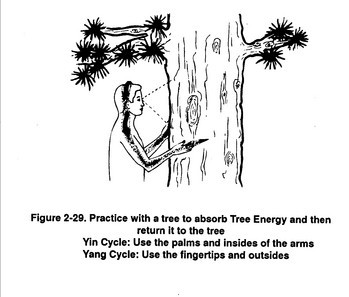
a.Use the Palms to Absorb Yin Chi and Help Balance Yang Energy (Figure 2-29)
Morning to noon time is the best time to practice with a tree.
1. Assume a Position. Stand or sit one or two feet in front of a tree.
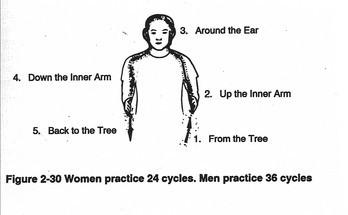
2. Open Yourself to a Tree. Relax and center yourself. Feel your boundaries soften. Allow yourself to become more receptive and somewhat vulnerable, ready to make contact with the tree. Feel your energy field open like a flower, neither emitting nor absorbing energy, just becoming open and available (Figure 2-30).
3. Offer a Welcome. Extend your arms and face the palms of your hands toward the tree. Extend your energy toward the tree with a friendly ‘offering” attitude. When the tree responds by extending its energy to you, accept it, breathing it into your body with an attitude of “welcome.” Use your mind and eyes as follows. With the lower part of the eyes, concentrate on the tip of your nose. With the upper part of the eyes, look at your palms and at the tree.
Let your intuition guide you as you respond to the tree again with another “offering” gesture. Proceed with several of these exchanges. Take your time and really feel what is happening.
Use the left palm, the mind, and the upper part of the eyes to absorb the Chi.
4. Parallel Tracking. Remain centered within yourself, neither approaching nor retreating, and simply observe the subtle relationship between you and the tree. Use meditative concentration to become very absorbed in your connection with the tree, without actively trying to change or analyze what is going on. Do not try to deepen the communion or lessen it. Control your own energy and watch the tree while the tree controls its own energy and watches you. This is known as Parallel Tracking. Such a neutral state may occur several times during a session at deep as well as shallow levels of intimacy.
5. Draw and Hold Close. Allow the energy field between you and the tree to intensify, thicken, and contract to Draw and Hold Close the two of you together. There may or may not be physical movement involved. The sensation is that the two of you are being enfolded in a cocoon of energy while more and more of your inner cores are exposed to each other. Finally you hold each other in an embrace of deep intimacy.
Drawing and Holding Close often happens spontaneously as the offering and welcoming escalates to become circulating and sharing, or as the circulating and sharing moves to deeper and deeper levels.
6. Guide the Chi. As with all Healing Tao practices, it is necessary that you train your eyes and mind to move and guide the Chi. This practice is also useful in training yourself to recognize and be aware of the quality of the tree’s energy. Feel the tree’s energy when it enters your body. As you send it out to the tree, combine it with Human Plane (Cosmic Particle) Energy. Notice how the energy feels when it returns to you from the tree: enhanced with a cool, healing quality. Notice also how the quality of the energy changes after nine, eighteen, 24, and 36 cycles.
Move the upper part of the eyes to guide the Chi slowly up the inside Yin side) of the left arm, to the left shoulder, the left side of the neck, the left ear, and the crown. From the crown move the Chi down the right side to the back side of the right ear, to the right neck, the right shoulder, inside the right arm, to the right palm. Project the Chi out into the tree trunk. Absorb the Chi again in a circle (the Yin Energy Circle): 36 cycles for men and 24 cycles for women. (Figure 2-30)

7.  Extend to a Deeper Level. Now begin to exchange energy with the tree on a deeper level. To share with the tree on a deeper level means to place a particular part of your body in contact with a particular part of the tree’s body, and breathing the energy back and forth between them. To circulate now means guiding the energy along a path which passes through both of your bodies and returns to its starting point. You can guide the Chi as in (6) above. Eventually you will discover many different patterns are possible.
8.  Drawing and Holding Back to End Gracefully. Drawing and Holding Back is very important. It prevents you from absorbing more energy from the tree than you can harmoniously utilize. It also prevents you from draining too much energy from a small or weak tree, or leaving such a tree with too much of your unprocessed negative energy. In addition, it seals off the connections you have made with the tree so that energy is not leaked into the environment after you leave. All in all, it makes for an aesthetically complete meditation and shows respect for the tree. When you have had enough and wish to begin your return to normal consciousness or just to a less deep level of communion, try to do so slowly and gradually so as not to disturb the beauty of what you have just shared. The sensation is one of gradually returning to yourself, sorting out the energy that belongs to you from the energy that belongs to the tree, and re-establishing the boundary between you.
It is important to note at this time that if, after you have done the healing, you still feel a lot of energy in your hands, close the crown point to seal it so that your healing energy will not continue to flow out.
{pagebreak}
Trees have a great liking for human contact and you will probably be ready to go long before the tree is ready to have you leave.
a. You need to gradually withdraw your attention from the contact, and turn your attention more upon yourself.
b. As you do this, much of the shared energy will be drawn into your body. When this happens, just “push back” at the stream of tree energy to prevent most of it from entering your body while allowing your human energy to return.
c. Then, when your polarities reverse, allow the tree energy to flow back into the tree, but keep your own conscious energy within your body.
d. After a couple of exchanges, the tree will get the idea and begin to cooperate with you. In a little while you will be fully back in your own body and ready for the closing.
e. To disengage from a powerful circulation pattern, gradually focus your attention on the navel area, the place to end the meditation. As the energy collects there, allow any excess to flow into the tree.
f. If the tree tries to feed you energy from another point, push back at this flow in the manner described above.
g. Eventually the pattern will cease, and you will be sharing energy with the tree at the selected point. Now you can sort out what energy belongs to you and what belongs to the tree to complete the drawing back.

h. When you are very deep into communion with a tree, you will probably have “too far to go” to draw back in one step. Instead, after a partial drawing and holding back, resume circulating and sharing, but in a less intense manner. Gradually, after several of these steps, you will some wholly back to yourself.
9. Closing. Always end with a closing. The closing is a precise and somewhat abrupt gesture which breaks the connection, locks into place any healing that may have occurred, and imparts a feeling of good will, all within a second or two. The closing may be a movement, a sound, or just a change in the subtle energy field, such as the clap of the hands, or a nod of the head. A smooth movement of a fist in an upward arc, ending with a little downward punch is very effective. The sounds “Ho” or “Amen” used to end prayers are also examples of closing gestures. So is a firm handshake, or a little squeeze at the end of a hug. Follow this with a little wave of the hand, or a quick kiss on the trunk to complete your closing.
Sections (7), (8), and (9) above are used to intensify, slow down, and end the exercises below and can be used at any time to end your communication with your selected tree.
b. Use the Fingers to Absorb Yang Energy to Help Balance the Yin Energy (Figure 2-29)
1.  Stand approximately one to two feet in front of a tree. Move slowly and smoothly, gradually approaching the tree. Feel the field of energy surrounding you become thick like honey.
2.  Extend your arms out toward the tree with your palms facing the tree and your fingers extended.
3.  As you slowly adjust your position to be closer and closer to the tree, less “honey” separates you from the bright energies found at its core.
4.  Similarly, your own radiance is revealed to the tree.
5.  At the same time the honey-like energy surrounding you acts like a protective cocoon, and your awareness of the outside world fades. As you arrive at the tree and wrap yourself around it in a big hug, your radiant energies link up with each other and you may lose yourself for a few moments in the bliss of union.
6.  After making contact in this way, you may need to hold still for a while until the new, deeper connections between you and the tree stabilize and simplify. Soon you will find yourself in the state of parallel tracking described previously from which circulating and sharing will develop.
7.  Feel the energy of the tree first. When you feel the tree’s Chi, use the mind, eyes, and lower part of the eyes to concentrate on the tip of the nose. The upper part of the eyes looks at the tips of the fingers and the tree.
8.  Use the left fingers, the mind, and the upper part of the eyes to absorb the Chi inward.
9.  Move the upper part of the eyes slowly to guide the Chi up the outside (Yang side) of the left arm, to the left shoulder, the left side of the neck, and the left ear to the crown. Move the energy down the right side beginning with the back side of the right ear, to the right neck, the right shoulder, outside the right arm, to the right palm and fingers. Project the energy out from the fingers, combine it with Cosmic Particle Energy, and guide it into the tree trunk. Absorb it again in a circle. Men repeat the cycle 36 times; women repeat the cycle 24 times. (See Figure 2-30)
10.  If you wish to end the experience at this or any point, follow the procedures of (a)(7), (8), and (9) above to intensify, slow down, and finally break your connection with the tree.
{pagebreak}
The Yang Energy Circle will help you become more sensitive to chronic and more superficial pain as well as the energy in the Yang organs (large and small intestines, gall bladder, bladder, and stomach).


c. Use the Palms to Absorb Tree Chi; the Yin Side
1.  Sit or stand approximately one to two feet in front of a tree.
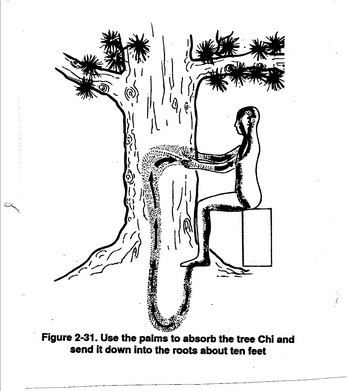
2. Extend your arms out toward the tree with your palms facing the tree. (Figure 2-31)
3. Feel the energy of the tree first. When you feel the Chi of the tree, use your mind, eyes, and palms to absorb the Chi through your palms. Move the Chi up the inside (the Yin sides) of both arms to both shoulders, both sides of the neck, and the left and right ears, to the crown. From the crown move the energy down the Functional Channel to the mid-eyebrow, throat, heart, solar plexus, navel, and the cauldron behind the navel.
4. Continue to move the energy down from the cauldron to the perineum, to the soles of the feet, and then approximately ten feet into the ground.
5. Bring the energy up to the roots of the tree, then up into the tree trunk. Feel your energy flow through the tree, then emerge from the trunk into your palm. Repeat the cycle nine, eighteen, 24, or 36 times.
6. Practice sending your energy through the tree trunk from the right palm, through the tree, to the left palm, and from the left palm, through the tree, to the right palm. Men should practice for 36 cycles; women should practice for 24 cycles. It is most important to feel your energy penetrate the tree.
7.  Practice distinguishing different parts of the tree. Start with the upper trunk. Send your energy into the trunk and feel it reverberate. Slowly kneel down to practice with the lower trunk. Then practice with the roots of the tree. Feel and exchange the force with the tree.
d. Absorb Tree Chi through the Crown
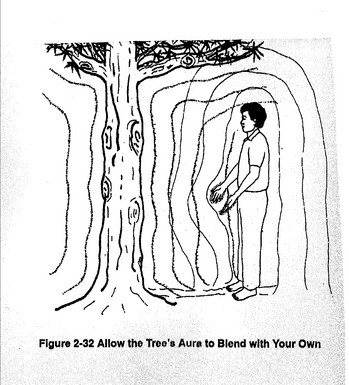
1.  Stand approximately two to three feet in front of a tree with your arms at your side. Feel the tree’s aura. (Figure 2-32) If you do not feel it, you can move in closer.
2.  When you feel the tree’s aura, use your crown to absorb the energy. The tree’s balanced energy can feel very gentle and soft and have a very powerful healing effect.
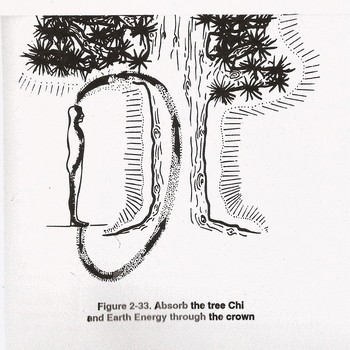
3.  Draw the tree energy into your crown and let it flow down through the Thrusting Channels or through the Functional Channel to the perineum, then down to both feet. Move the energy out through the soles of your feet into the ground. Bring the energy from the ground to the roots of the tree, then up its trunk.
4.  Feel yourself absorb the Earth Energy and the tree energy. (Figure 2-33) Feel them purify your energy, removing negativity and sick energy. When you feel it emerge from the trunk of the tree, absorb the Human Plane (Cosmic Particle) Energy, and return the energy to your crown. You will feel the combined energies nourish your brain, glands, and organs. Repeat the process nine, eighteen, or 36 times.
{pagebreak}
e. Share with the Tree from the Heart
In this pattern tree energy is run through the arms and heart center. It may be used to clear a healer’s arms of sick energy accumulated in work, or just to open the heart.
1.  Assume any comfortable position in which your hands can easily reach a branch.
2.  Reach one arm out to touch the tree with the palm or fingertips. Feel the vital energy just under the bark and make contact with it, allowing some time for the contact to develop.
3.  After a while you will feel the sharing begin as a gentle breathing back and forth between your hand and the tree.
4.  Gradually extend the process until you are breathing energy through the entire length of the arm, back and forth from your heart center to the tree. Let this back and forth sharing go on for some time.
5.  Next, get the other arm involved. It may rest on the same branch, near the other hand, or it may rest on an entirely different branch.
6.  Allow the tree energy to flow in along one arm, mix with your own energy in the heart center, and flow out the other arm. Every so often reverse the direction of flow in one or both arms.
7.  For a deeper experience try extending the flow from the heart down to the navel, letting it go from tree to heart, to navel, and back.
8.  Where does the energy go after it leaves your hands and enters the tree? By following it with your mind, you will begin to discover more about the subtle anatomy of the tree.
9.  You may find blocked or congested areas that you can work on by running energy out one hand and into the other. Feel the tree’s response to your efforts, and let intuition guide you.
f. Absorb Earth Energy
1.  Create warmth in your navel and bring the energy up to the crown.
2.  Project the Chi out into the top of the trunk of the tree. Enter the tree and feel that you have a connection with it.
3.  During this process you can stand farther away from the tree (ten to thirty feet). As your practice continues you can project your energy easily from far away into the tree. Let the tree take in your negative or sick energy. The energy you receive back will be balanced.
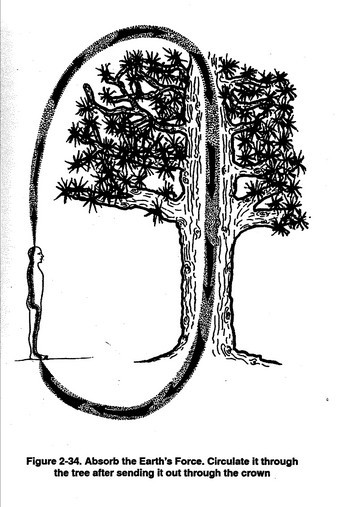
4.  Let your energy flow down the trunk of the tree to its roots and into the Earth. (Figure 2-34) Let the Earth Energy purify your energy. Bring this combined energy up through the soles of your feet to the perineum, then up through the Thrusting Channels, or through the Governor Channel running up the spine. Let the energy flow up to the crown and project it outward again. Repeat the process nine, eighteen, or 36 times.

The more you repeat the process, the more your energy will refine and increase. You will notice the Thrusting Channels and the Microcos¬mic Orbit are cleaner and brighter. Once you have established a good connection with the tree, you can send your sick energy to the tree from a far distance to refine your energy or improve your health.

g. Meditate While Sitting Under a Tree
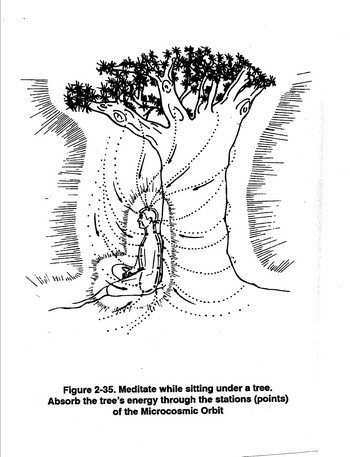
Once you have developed the ability to feel the tree’s Chi, you can sit under the tree and meditate. Draw the tree’s energy into you through the stations (points) of the Microcosmic Orbit. (Figure 2-35)
Shouldn’t this be part of everyone’s education?